Contracts form the foundation of commercial and personal transactions. For a contract to be legally enforceable in Uganda, it must meet specific requirements established by law. This guide explains the essential elements that make a contract binding and enforceable.
What is a Contract?
A contract is a legally binding agreement between two or more parties that creates obligations enforceable by law. The Contract Act of Uganda and common law principles govern contracts in Uganda.
Essential Elements of an Enforceable Contract
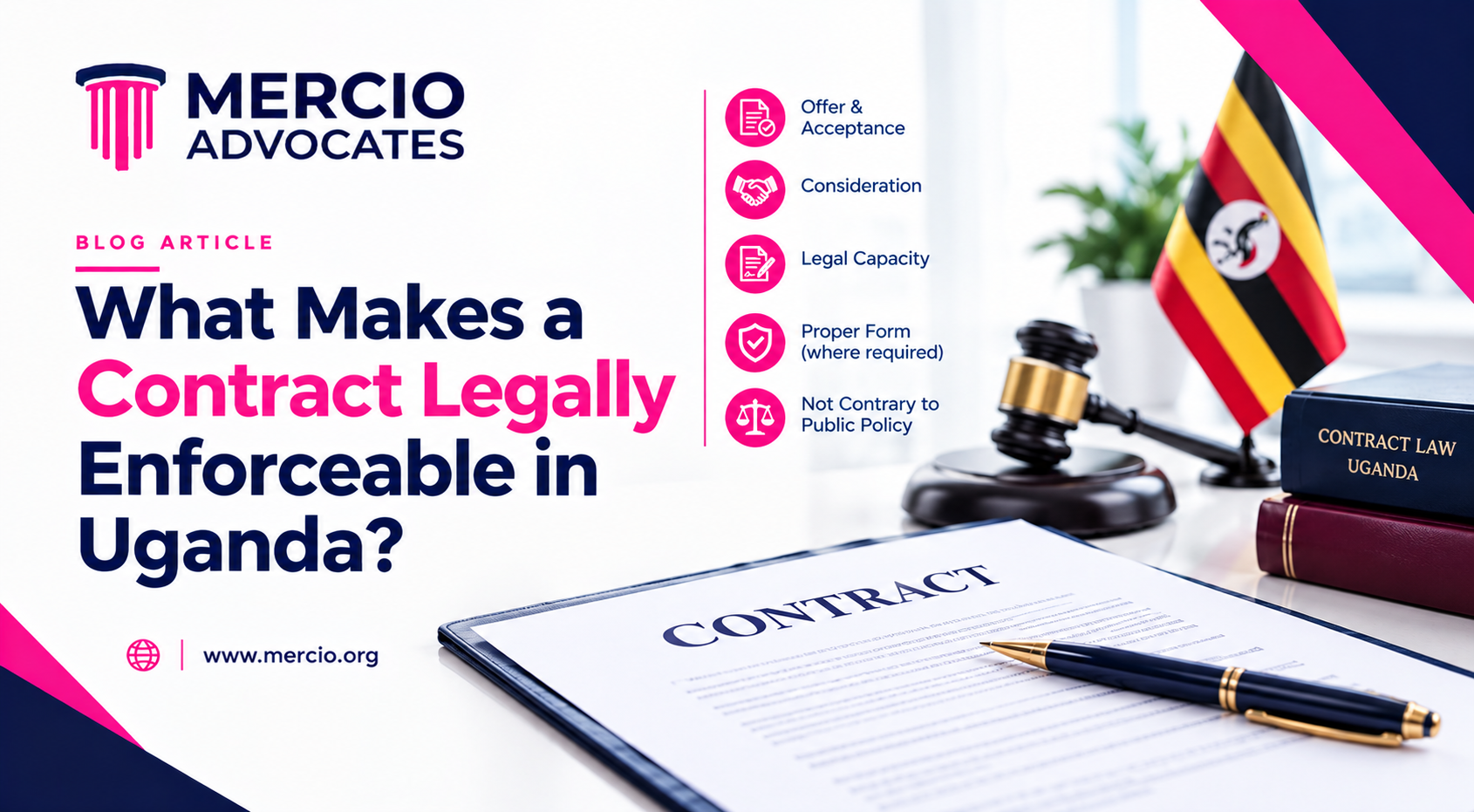
For a contract to be legally enforceable in Uganda, it must contain the following essential elements:
1. Offer
An offer is a clear expression of willingness to enter into a contract on specific terms. It must be communicated to the offeree and be capable of acceptance.
- The offer must be definite and certain
- It must be communicated to the offeree
- The offeror must intend to be bound
- The offer can be terminated by revocation, rejection, or lapse of time
2. Acceptance
Acceptance is the unconditional agreement to the terms of the offer. It must be communicated to the offeror and be in the manner prescribed by the offer.
- Acceptance must be absolute and unconditional
- It must be communicated to the offeror
- Silence generally does not constitute acceptance
- Acceptance must be in the mode prescribed by the offer
3. Consideration
Consideration is something of value exchanged between the parties. It can be a promise to do something or to refrain from doing something.
- Consideration must be sufficient but need not be adequate
- It must move from the promisee
- Past consideration is not valid consideration
- Consideration must be legal
4. Intention to Create Legal Relations
The parties must intend that their agreement is legally binding. Commercial agreements are presumed to have this intention, while social and domestic agreements are not.
- Presumption in commercial contracts
- No presumption in social or domestic arrangements
- The intention can be rebutted by evidence
- Written contracts provide clear evidence of intention
5. Capacity to Contract
The parties must have the legal capacity to enter into a contract. Certain persons lack capacity, including:
- Minors (persons under 18 years)
- Persons of unsound mind
- Bankrupts under certain circumstances
- Corporations acting beyond their powers
6. Legality of Purpose
The purpose of the contract must be legal. Contracts with illegal purposes are void and unenforceable.
- Contracts involving illegal activities are void
- Contracts contrary to public policy are void
- Contracts that undermine the legal system are void
Additional Requirements
Some contracts require additional formalities to be enforceable:
- Contracts for land must be in writing
- Contracts of guarantee must be in writing
- Contracts for marriage must be in writing
- Contracts that cannot be performed within one year must be in writing
When is a Contract Not Enforceable?
A contract may not be enforceable if:
- There is a mistake about a fundamental term
- There has been misrepresentation or fraud
- There was duress or undue influence
- The contract is unconscionable
- The contract has been frustrated
Need Help Drafting or Reviewing Contracts?
At Mercio Advocates, we provide expert legal assistance with contract drafting, review, and negotiation. Our experienced attorneys ensure your contracts are legally enforceable and protect your interests.