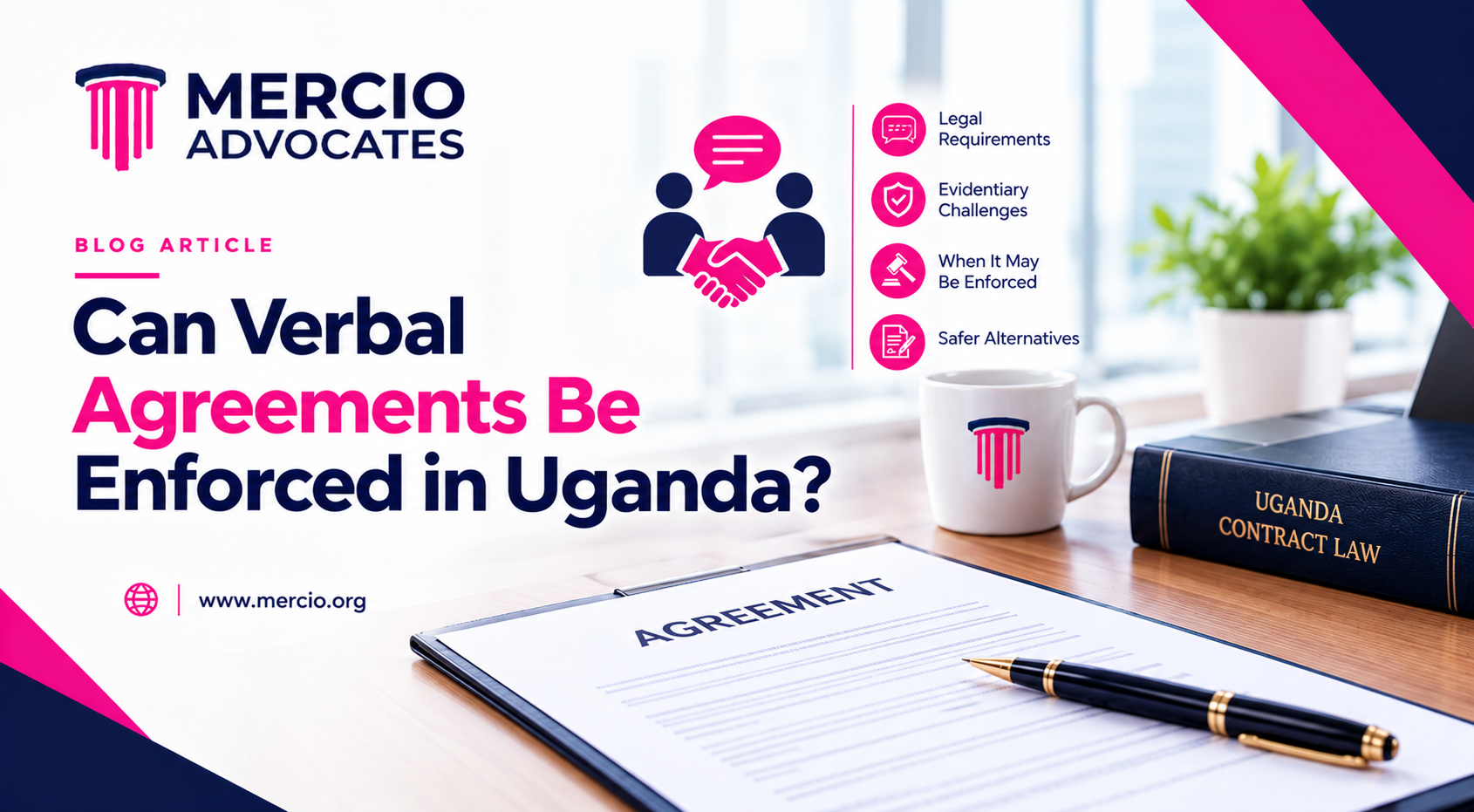
A common question in business and personal dealings is whether verbal agreements are legally enforceable in Uganda. While oral contracts can be binding, they present unique challenges and limitations that you should understand.
The General Rule: Verbal Agreements Are Enforceable
Under Ugandan law, verbal agreements are generally enforceable, provided they meet the essential elements of a contract. The Contract Act does not require all contracts to be in writing.
Essential Elements Must Be Present
For a verbal agreement to be enforceable, it must contain all the essential elements of a valid contract:
- Offer and acceptance
- Consideration
- Intention to create legal relations
- Capacity to contract
- Legality of purpose
When Must a Contract Be in Writing?
Certain types of contracts must be in writing to be enforceable under Ugandan law:
- Contracts for the sale or transfer of land
- Contracts of guarantee (surety agreements)
- Contracts for marriage
- Contracts that cannot be performed within one year
- Contracts for the sale of goods above a certain value (Statute of Frauds)
- Contracts involving the creation of a trust
Challenges of Enforcing Verbal Agreements
While verbal agreements are legally enforceable, they present several challenges:
1. Proving the Terms
The biggest challenge with verbal agreements is proving the exact terms agreed upon. Without written documentation, parties may have different recollections of what was agreed.
2. Statute of Frauds
The Statute of Frauds requires certain types of contracts to be in writing. If the contract falls under this category, a verbal agreement will not be enforceable.
3. Evidence Issues
In court, evidence of a verbal agreement may be limited to witness testimony, which can be unreliable. The court may require corroborating evidence.
Best Practices for Verbal Agreements
If you must enter into a verbal agreement, consider these best practices:
- Follow up with a written confirmation of the agreement
- Keep detailed notes of what was agreed
- Have a witness present during the discussion
- Document the key terms in an email or letter
- Consider recording the conversation (with consent)
When to Consult an Attorney
You should consult an attorney when:
- The agreement involves significant value
- The agreement relates to land or property
- The agreement involves long-term obligations
- There is a dispute about the terms of a verbal agreement
- You are unsure about the enforceability of an agreement
Need Help with Contract Matters?
At Mercio Advocates, we provide expert legal advice on all contract matters, including verbal agreements. Our experienced attorneys can help you draft enforceable contracts and resolve disputes.