
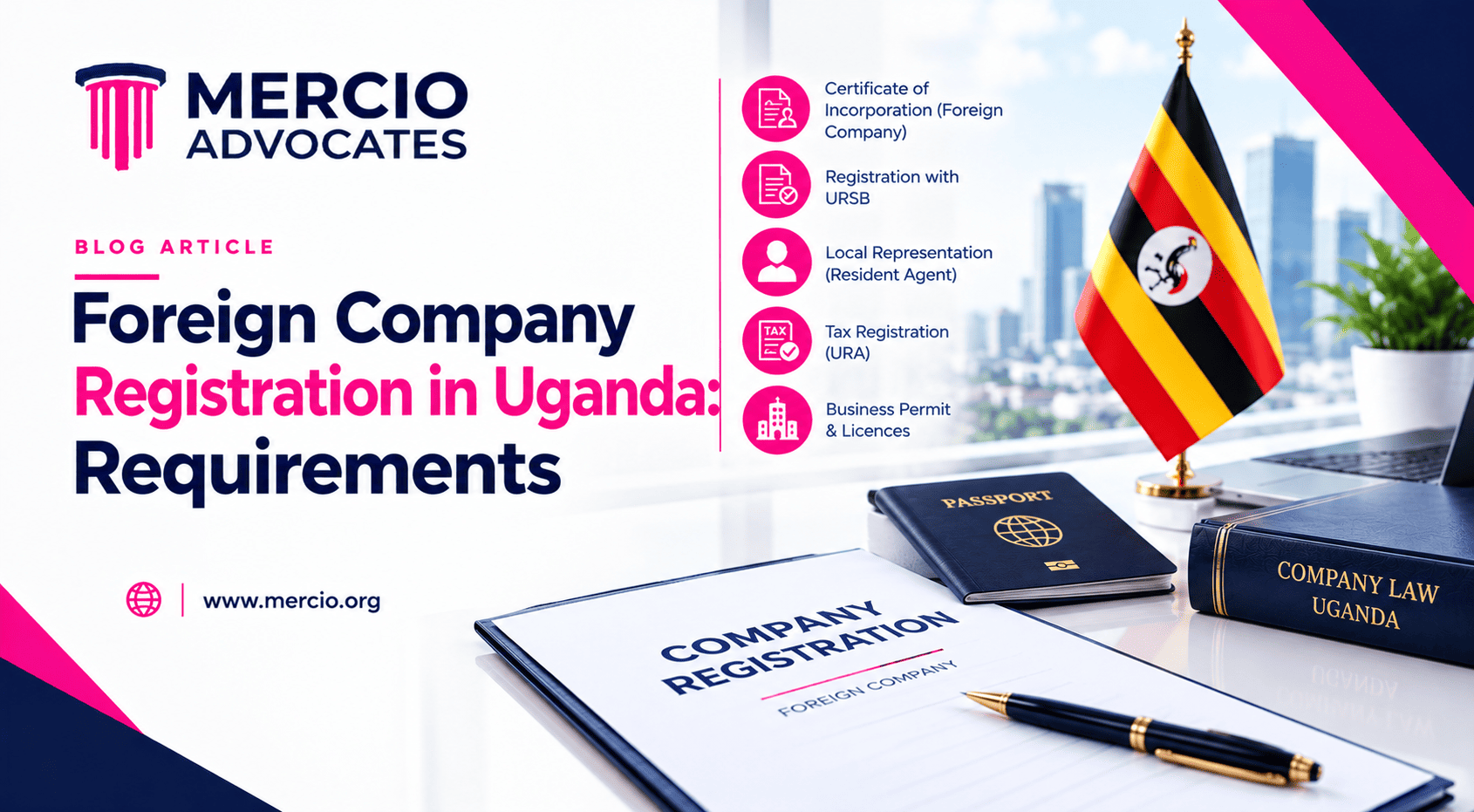
Foreign company registration in Uganda is done with the Uganda Registration Services Bureau (URSB) within 30 days of establishing a place of business in the country. The company must file a certified copy of its charter or memorandum and articles, a list of its directors and secretary, the names and addresses of persons resident in Uganda authorised to accept service on its behalf, and the address of its registered or principal office abroad, together with the prescribed fees.
Registration is only part of the picture. Tax registration, licences, bank accounts and work permits come afterwards and have their own requirements. This guide separates the two so you know exactly what URSB needs and what follows.
Who needs foreign company registration in Uganda?
A company incorporated outside Uganda that establishes a place of business in Uganda must register with URSB under the part of the Companies Act that deals with foreign companies (now the Companies Act, Cap. 106 in the 2023 revised laws). This is often called registering a branch. The branch is not a new company; it is the foreign company itself, operating in Uganda.
If you would prefer a separate Ugandan company, you incorporate a subsidiary instead. We explain the difference, and the advantages of each, in can a foreign company open a branch in Uganda, and the ownership rules for foreign shareholders in can a foreigner own a company in Uganda.
Documents required for foreign company registration
URSB's company forms list refers to section 252 of the Companies Act and the following documents, which must be delivered to the Registrar within 30 days after the foreign company establishes a place of business in Uganda:
| Requirement | What it means in practice |
|---|---|
| Certified copy of the charter, statutes or memorandum and articles | The company's constitutional documents from its home country, certified, with a certified English translation if they are in another language. Notarisation is usually expected for documents executed abroad. |
| List of directors and secretary (URSB Form 24) | Full particulars of each director and the secretary. Passport copies of the directors are normally requested. |
| Persons authorised to accept service (Form 25) | The names and addresses of one or more persons resident in Uganda who can accept legal documents and notices for the company. |
| Address of the registered or principal office (Form 26) | The full address of the company's registered or principal office in its home country. |
| Statement of subsisting charges | Details of any existing mortgages or charges over the company's property, or a statement that there are none. |
The certificate of incorporation of the parent company and a board resolution approving the Ugandan branch are also commonly prepared, because URSB, banks and other agencies ask for evidence that the branch was properly authorised.
Fees
Foreign company fees are charged in US dollars. At the time of writing, the URSB fee schedule lists USD 350 for registering the certified copy of the charter, statutes or memorandum and articles, USD 70 for each other document or form, and USD 70 for a return filed by a foreign company. Certification of copies is charged separately. Fees change, so confirm the current figures before you budget.
Step-by-step: registering a foreign company in Uganda
- Decide on the structure. Confirm that a branch, rather than a subsidiary, fits your liability, tax and licensing needs.
- Collect and certify the parent documents. Obtain certified and, where needed, notarised copies of the charter or memorandum and articles, and certified English translations.
- Appoint persons to accept service. Choose one or more people resident in Uganda and confirm their addresses.
- Prepare the URSB forms. Complete the list of directors and secretary, the list of persons authorised to accept service, the address of the principal office and the statement of charges.
- File online and pay. Submit the documents through URSB's online system and pay the assessed fees.
- Respond to queries. The Registrar may ask for clarification or corrected documents.
- Receive the certificate of registration. Once approved, URSB issues the certificate confirming registration of the foreign company.
Remember the 30-day period. It runs from when the company establishes a place of business in Uganda, so file early rather than waiting until operations are already under way.
What happens after registration
The FAQ on our business law page lists several items, such as a trading licence, tax registration, bank accounts and work permits. These are essential, but they are not URSB registration requirements. They come after the certificate is issued:
- Uganda Investment Authority. Foreign investors must register with the UIA before they invest in or operate an investment activity, under the Investment Code Act, 2019.
- Tax registration. Obtain a Tax Identification Number (TIN) from the Uganda Revenue Authority and register for the taxes that apply, such as income tax, PAYE, withholding tax and VAT where turnover reaches the threshold.
- Trading licence. Obtain a trading licence from the local authority where you operate, for example Kampala Capital City Authority in Kampala, together with any sector licence.
- Bank account. Banks will ask for the URSB certificate, the TIN, the parent company's documents and identification for signatories.
- Work permits. Foreign managers and staff need the appropriate entry permits before they start work.
- NSSF. Register with the National Social Security Fund once you employ staff in Uganda.
Ongoing obligations for a registered foreign company
Registration is not a one-off event. A foreign company must notify URSB of changes to the registered particulars, such as changes of directors, of the persons authorised to accept service or of the principal office address, and must file the returns the Act requires. It must also keep proper accounting records for its Ugandan operations and meet its tax filing deadlines. If the company stops having a place of business in Uganda, it should notify URSB. Missing these obligations can lead to penalties and problems with banks, tenders and licence renewals.
Common reasons for delay
- Constitutional documents that are not properly certified or translated.
- Names and passport details that do not match across documents.
- No resident person nominated to accept service.
- Filing after the 30-day period, or starting to trade before registration and licensing are complete.
How Mercio Advocates can help
Our business law advocates help foreign companies set up in Uganda, from choosing between a branch and a subsidiary to preparing and filing URSB documents, regulatory compliance, contracts and taxation. We can coordinate the post-registration steps so your branch can open its doors with fewer delays. Call +256 785 390 207, email info@mercio.org or book an appointment with our business law team.
This article provides general information about the law in Uganda and is not legal advice. Requirements, forms and fees change and should be confirmed with URSB or our office before you rely on them. For advice on your situation, please contact Mercio Advocates.