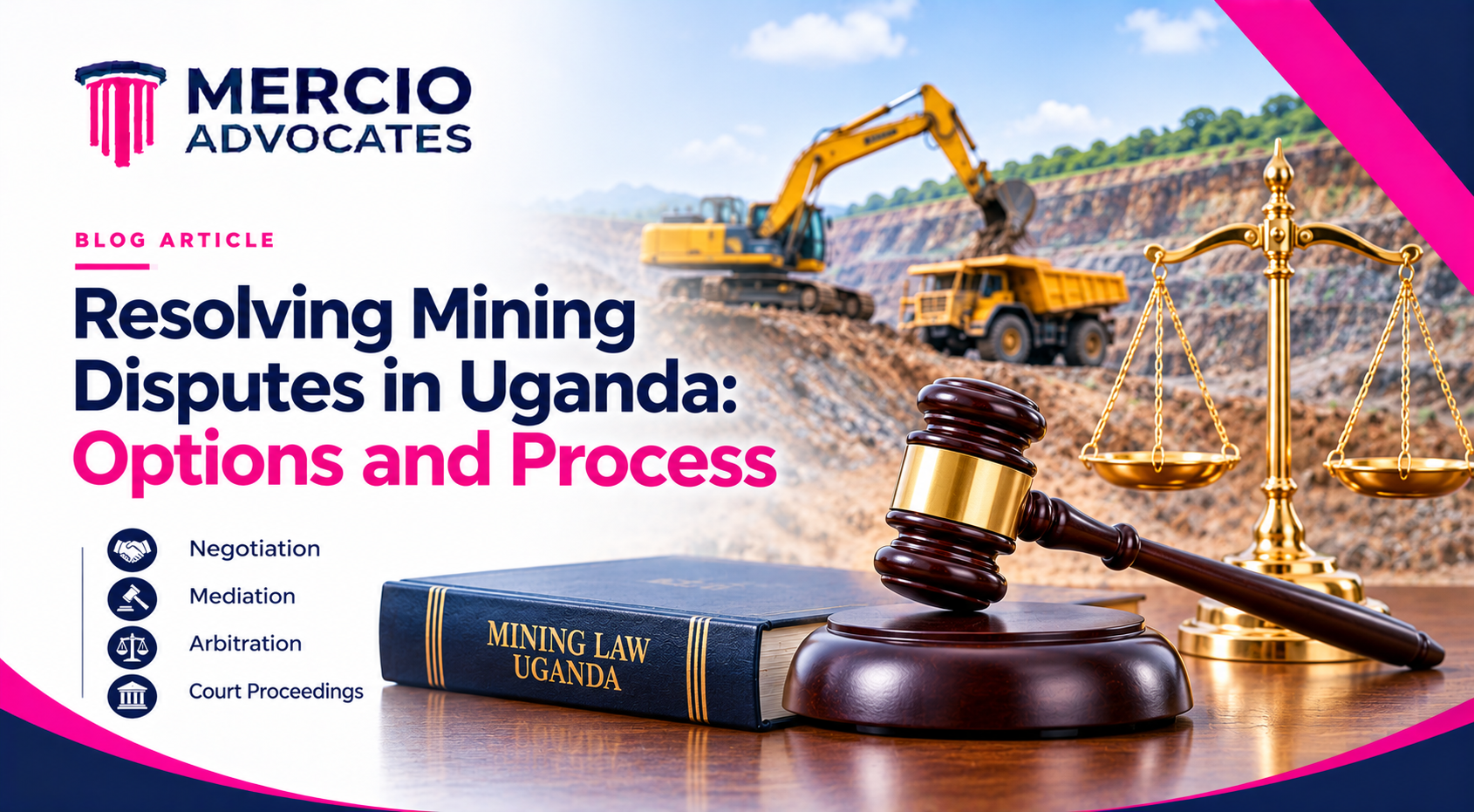
Mining disputes in Uganda are usually resolved through negotiation and mediation, arbitration where the contract or mineral agreement provides for it, or litigation in the courts. The Mining and Minerals Act, 2022 also provides specific routes: local governments take part in resolving disputes between communities and licence holders, mineral agreements may provide for local dispute mechanisms and arbitration, and a person aggrieved by the Minister's decision on an objection may appeal to the High Court within thirty days.
The right route depends on who the dispute is with, what the contract says and how quickly a decision is needed. This guide explains the common types of dispute and the options for each.
Common types of mining disputes in Uganda
- Licence and regulatory disputes: objections to licence applications, overlapping licence areas, refusals, suspensions or cancellations, and disagreements over fees or royalties.
- Land use and compensation: disputes with landowners, customary owners and occupants over access, surface rights and the amount or recipients of compensation.
- Community disputes: claims that promises on jobs, projects or environmental protection have not been kept.
- Artisanal and licensed miners: conflicts where informal miners work within a licensed area.
- Commercial disputes: joint venture disagreements, supplier and contractor claims, offtake and mineral sale contracts, and unpaid invoices.
- Gold and mineral trade disputes: non-delivery, wrong purity, fraud or failed export permits.
What the Mining and Minerals Act, 2022 says about disputes
The Mining and Minerals Act, 2022 contains several dispute-related provisions:
- Objections and appeals. Under section 33, a person aggrieved by the Minister's decision on an objection may appeal to the High Court within thirty days. Missing this deadline can end the challenge, so act quickly.
- Local government role. Section 27(1) gives local governments the role of facilitating dialogue between communities or project affected persons and licence holders, and of participating in resolving disputes arising from mineral operations together with the Directorate.
- Mineral agreements. Section 28(2) allows mineral agreements to provide for culturally relevant local dispute resolution mechanisms and for resolution of disputes through arbitration.
The Minister may also make regulations on dispute procedures and appeals, so check the current regulations and any Ministry guidance for the specific type of dispute.
Your options for resolving mining disputes in Uganda
Negotiation
Most disputes start with direct talks. A lawyer can set out your position in writing, gather evidence, and propose a solution that protects the licence and the relationship. Agreements reached should be recorded and signed.
Mediation
A neutral mediator helps the parties reach their own settlement. Mediation is fast, confidential and suits community and landowner disputes, where the parties will need to keep working together. Local government officials, cultural leaders or professional mediators may be involved. Ugandan courts also refer many civil cases to mediation.
Arbitration
Where a contract or mineral agreement contains an arbitration clause, the dispute is decided privately by one or more arbitrators under the Arbitration and Conciliation Act, and the award is binding and enforceable through the courts. Arbitration is common in joint venture, offtake and investor agreements because the parties can choose experienced arbitrators, the seat and the rules, and keep proceedings confidential.
Litigation
Court action is needed where there is no arbitration clause, where urgent orders such as injunctions are required, for appeals under section 33, and for judicial review of unlawful administrative decisions. Commercial disputes usually go to the Commercial Division of the High Court, and land disputes to the Land Division or the relevant High Court circuit.
| Option | Best for | Outcome |
|---|---|---|
| Negotiation | Early, low-value or relationship disputes | Signed settlement |
| Mediation | Community, landowner and partner disputes | Voluntary settlement, can be recorded by court |
| Arbitration | Contracts with arbitration clauses, investor disputes | Binding award |
| Litigation | Urgent orders, appeals, no arbitration clause | Court judgment, appealable |
Step by step: handling a mining dispute
- Check deadlines immediately. Note any appeal period, such as the thirty days under section 33, contract notice periods and limitation periods.
- Read the documents. Review the licence, mineral agreement, joint venture or supply contract, land use agreements and community agreements, especially the dispute clauses.
- Preserve evidence. Keep correspondence, survey maps, payment records, photos, environmental reports and cadastre records.
- Give formal notice. Send a written notice of dispute as the contract requires, setting out the issue and what you want.
- Try negotiation or mediation where the contract or the situation allows, often with local government involvement for community matters.
- Escalate to arbitration or court if settlement fails, seeking urgent orders where operations, equipment or minerals are at risk.
- Implement the outcome and update agreements, community commitments and compliance systems to prevent a repeat.
For contract claims, our guide on what happens when a contract is breached in Uganda explains remedies such as damages and specific performance. For community issues, see mining community development agreements in Uganda.
Disputes with artisanal miners
A frequent problem is finding artisanal miners already working inside a newly licensed area. Forcible removal without lawful process can lead to violence, criminal complaints and lasting community hostility. Licence holders should document the situation, engage the miners and local leaders, involve the district and the Directorate, and explore options such as formalising the miners, agreed relocation or supply arrangements. Where a negotiated solution fails, lawful enforcement through the authorities or the courts is the safer route.
Arbitration or court: how to choose
If your contract already has an arbitration clause, the court will generally refer the dispute to arbitration. If you are drafting a new contract, consider who your counterparty is, where its assets are, whether confidentiality matters, and whether you may need urgent court orders. Many mining contracts combine negotiation and mediation steps with arbitration, while preserving the right to seek urgent interim relief from a court.
Preventing disputes
- Include clear dispute resolution clauses, with a step from negotiation to mediation to arbitration, in every major contract.
- Verify licence boundaries and status before investing or starting work.
- Pay compensation to the right people, with full documentation.
- Run a grievance mechanism that communities trust.
- Keep regulatory filings and renewals up to date.
How Mercio Advocates can help
Our mining law practice offers legal representation through arbitration, mediation and litigation in land use conflicts, compensation claims, contract disputes and regulatory compliance matters. We start by assessing your position and deadlines, and we explain realistic options and likely costs before you commit to a route.
Visit us at Plot 10 Luwum St, California Plaza, Kampala (Mon-Fri 8:00-18:00, Sat 9:00-13:00), call +256 785 390 207, email info@mercio.org, or book a consultation about your dispute.
This article is general information about Ugandan mining law and is not legal advice. The law, regulations, fees and Ministry procedures change, and every project turns on its own facts. For advice on your situation, contact Mercio Advocates on +256 785 390 207 or info@mercio.org.